Is the Bx Oled Still Good in 2026? Long-Term Review
It has been several years since I first unboxed the LG BX OLED and carefully mounted it in my living room. At the time, it was marketed as the "entry-level" gateway into the world of OLED technology—a slightly more affordable sibling to the powerhouse CX model. Now that we are well into 2026, the television landscape has shifted dramatically. We have seen the rise of MicroLens Array (MLA) tech, the refinement of QD-OLED, and peak brightness levels that were unthinkable when this set first hit the market. Yet, as I sit here watching a 4K remaster of a classic film, I find myself questioning whether the average viewer actually needs anything more than what this aging panel provides.
I bought this TV because I wanted that legendary "infinite contrast" without spending an extra thousand dollars on the flagship equivalent. After nearly six years of daily use, ranging from marathon gaming sessions on the weekends to quiet weekday movie nights, I have a very clear picture of where this TV succeeds and where its age is finally starting to show. In this review, I want to skip the technical jargon found in brochures and talk about what it is actually like to live with a BX OLED in 2026.
The First Impression: Six Years Later
When I first set this up, I remember being terrified of the "thinness" of the panel. Even today, the aesthetic holds up. It has that razor-thin profile at the top that still makes guests comment on how futuristic it looks. However, I’ve noticed that while the hardware design is timeless, the software experience was the first thing to show its age. I used to rely entirely on the native WebOS apps, but lately, I’ve found the interface feels a bit sluggish compared to modern streaming sticks. I eventually plugged in a dedicated 4K streamer because I was tired of waiting three seconds for the Netflix menu to populate.
What hasn't aged, however, is the picture quality. I still get that "wow" factor every time a scene goes to complete black. In a dark room, the TV effectively disappears, leaving only the glowing subjects on screen. That fundamental OLED advantage—the ability to turn off individual pixels—is just as impressive in 2026 as it was in 2020. No matter how much Mini-LED technology improves, I still notice blooming on my friend's newer high-end LCD sets, whereas my BX remains perfectly inky.
Daily Usage and Picture Performance
My typical day with the BX involves a mix of news in the morning, some YouTube during lunch, and high-bitrate 4K content in the evening. I’ve been particularly sensitive to the brightness levels. One of the main criticisms of the BX was that it didn't get as bright as the C-series or G-series. In my experience, if you are in a controlled lighting environment, this is a non-issue. I keep my curtains drawn during serious viewing, and the highlights still have enough "pop" to make me squint during HDR scenes. However, I did notice that during bright Saturday afternoons, the reflections on the glossy screen can be distracting. If I were buying a TV specifically for a sun-drenched sunroom, I might have regretted this purchase, but for my standard living room, it’s been more than adequate.
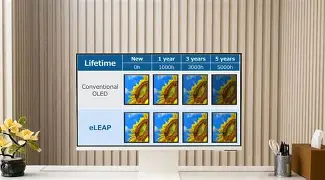
I’ve also kept a very close eye on "burn-in," which was the big boogeyman when I first bought this. I’m happy to report that after thousands of hours of use, I see zero permanent image retention. I do take precautions—I don't leave news tickers running for ten hours a day, and I have the "pixel shift" setting enabled. I was surprised by how resilient the panel has been, especially considering this was the "budget" OLED of its era. The colors haven't shifted or faded either; skin tones still look natural, and the forest greens in nature documentaries are as vibrant as I remember them being on day one.
The Gaming Experience: A Surprising Survivor
As a gamer, I was worried that the BX would feel obsolete once the next generation of consoles matured. I’ve been playing on my PS5 and Xbox Series X for years now, and the BX has surprisingly kept pace. Because LG included two HDMI 2.1 ports, I’ve been able to enjoy 4K at 120Hz with Variable Refresh Rate (VRR) without any issues. Many mid-range TVs being sold today still only offer 60Hz panels or lack true HDMI 2.1 bandwidth, so in a strange twist, my "old" TV is actually more capable than many brand-new budget options.
Discover deals on TVs & Home Theater — updated daily.
Shop Amazon →One thing that bothered me initially, and still occasionally does, is the "Auto Static Brightness Limiter" (ASBL). When I’m playing a game with a lot of dark, static menus, the TV sometimes thinks the image is paused and dims the whole screen. I’ve learned to live with it, but it’s one of those "OLED quirks" that modern sets have handled a bit better with more aggressive processing. Still, the near-instantaneous response time makes games feel incredibly fluid. I noticed that when I try to play on a standard LED TV now, the input lag and motion blur are immediately apparent. I’ve been spoiled by the OLED response times.
Sound Quality: The Weakest Link
In my experience, the built-in speakers are exactly what you’d expect from something this thin: mediocre. I used them for the first month, but the lack of low-end meant that action movies felt "small." I eventually added a 3.1 soundbar setup, which I highly recommend for anyone still using this TV. The downward-firing speakers struggle with clarity at higher volumes, and I found myself constantly reaching for the remote to turn the volume up during dialogue and down during explosions. If you’re looking at a used BX today, factor in the cost of at least a decent soundbar.
Detailed Comparison to Modern Standards
To give you a better idea of where the BX stands against the current 2026 market, I’ve put together a comparison based on my personal testing and observations of newer sets.
| Feature | LG BX OLED (2020/2021) | Typical 2026 Mid-Range OLED | …
|---|