I Tested the Claw Grip for a Month: Here is My Verdict
For many people, a mouse is just a mouse. But for anyone who spends long hours gaming, editing, coding, or working across multiple monitors, grip style can make a surprising difference in comfort, accuracy, and fatigue. Among the most discussed styles is the claw grip, a hand position that sits between the relaxed palm grip and the highly fingertip-driven alternative. It is often praised for its speed, control, and responsiveness, especially in fast-paced use.
Over the course of a month, the claw grip was tested in real-world conditions across work and play: daily office tasks, long browsing sessions, photo editing, and several genres of PC gaming. The goal was simple: determine whether the claw grip is actually better, who it suits best, what compromises it brings, and whether it improves the overall mouse experience enough to justify changing habits.
The short version is that the claw grip can be excellent, but it is not universally comfortable or automatically superior. It rewards the right hand size, the right mouse shape, and the right usage pattern. For the right user, it can feel faster and more precise than a palm grip. For the wrong user, it can lead to tension and fatigue. After a full month of testing, the verdict is clear: the claw grip is a strong option for performance-focused users, but only when ergonomics and expectations are properly matched.
What Is the Claw Grip?
The claw grip is a mouse-holding style where the base of the palm lightly contacts the rear of the mouse while the fingers arch upward, creating a claw-like shape. The fingertips and lower palm handle most of the control, while the middle section of the hand hovers more than it would in a palm grip.
In practical terms, this gives the user a hybrid feeling. It is not as fully supported and relaxed as palm grip, but it is not as airy and fingertip-dependent as fingertip grip either. That balance is exactly why many users are drawn to it. It tends to offer quicker click actuation, faster micro-adjustments, and a greater sense of agility, especially in situations where fast cursor corrections matter.
Buyers usually care about three things when evaluating the claw grip:
- Comfort over long sessions, especially for work or extended gaming
- Precision and responsiveness in everyday navigation or competitive play
- Mouse compatibility, since some shapes clearly favor claw grip more than others
How the Claw Grip Was Tested
To judge the claw grip fairly, it was used as the primary mousing style for a full month without switching back to a preferred grip except for short comparison checks. The testing included approximately eight to ten hours of total daily mouse use, split between productivity and entertainment.
Testing Conditions
The month-long evaluation included the following common use cases:
- Office productivity: spreadsheets, email, browser tabs, document editing, and multitasking
- Creative work: image editing, timeline navigation, and precision cursor placement
- General computing: browsing, scrolling, dragging files, and prolonged desktop use
- Gaming: first-person shooters, strategy titles, and action games requiring both fast flicks and controlled tracking
The focus was not only on raw performance but also on the subtle factors many people overlook during a quick store demo or first-week impression: wrist strain after several hours, finger fatigue, button control consistency, and whether the grip remained comfortable when attention shifted from the grip itself to the task at hand.
First Impressions: Fast, Precise, and Slightly Awkward
The first few days with the claw grip felt promising but not effortless. The immediate advantage was a stronger sense of cursor liveliness. Small adjustments were easier, and clicks felt more deliberate. In games, particularly shooters, quick target corrections felt more natural than with a flatter palm grip. In desktop use, moving between interface elements seemed snappier.
At the same time, the claw grip demanded more from the hand. The arched finger position creates a more engaged posture. Rather than resting passively, the hand remains partially active. That is part of what gives the grip its responsiveness, but it is also the source of its biggest drawback. During the first week, the hand noticed the difference almost immediately.
Users considering the claw grip should know this upfront: it can feel less comfortable before it feels better. There is an adaptation period, and whether that period pays off depends heavily on muscle tension, mouse size, and how naturally the fingers settle into the shape.
Performance After a Month
1. Cursor Control and Precision
This was where the claw grip delivered its strongest results. Because the fingers remain arched and ready to react, the mouse felt highly controllable in short bursts. Fine aiming movements, quick cursor corrections, and repeated click actions all benefited from the extra finger engagement.
For gaming, the grip offered a clear advantage in scenarios requiring rapid directional change. Flick shots and snap corrections felt easier than with a traditional palm grip. In productivity work, that translated into more accurate selection of small interface elements, timeline markers, and detailed editing controls.
For buyers who prioritize precision over passive comfort, this is the claw grip’s main selling point.
2. Speed and Responsiveness
The second major strength was speed. Since the hand does not fully drape over the mouse, movements can feel lighter and more immediate. The claw grip encourages a style that blends wrist motion with finger-driven adjustment, making it especially effective for users who dislike the heavier feeling of a full palm contact style.
Find top-rated Electronics products at great prices.
Shop Amazon →That faster response was noticeable in daily use. Switching among windows, selecting tabs, and performing repetitive interface interactions felt efficient and sharp. The mouse never felt sluggish in hand, assuming the shape supported the grip properly.
3. Comfort Over Long Sessions
This was the most mixed area. After a full month, the claw grip became more natural, but it never became as effortlessly relaxed as a palm grip. During medium-length sessions of one to three hours, comfort was generally good. During especially long stretches, the extra finger tension could still be felt.
Users who naturally tense their hands or curl their fingers too aggressively may run into discomfort sooner. The most common pressure points were:
- Finger joints from sustained arching
- The base of the palm from partial support
- Wrist tension when desk height or mouse position was not ideal
In short, the claw grip was comfortable enough for sustained use, but not universally ideal for marathon sessions unless paired with a mouse that truly fits.
4. Fatigue and Ergonomics
This is where marketing hype usually fades and real ownership experience begins. The claw grip is often described as high-performance, but performance and ergonomics do not always align perfectly.
After a month, the overall fatigue level was acceptable, but clearly more noticeable than with a relaxed palm setup. The difference was not severe, yet it was consistent. On high-workload days, the hand felt more “engaged” at the end of the day. Some users will interpret that as improved control; others will interpret it as unnecessary strain.
The grip worked best when the mouse allowed the rear shell to support the lower palm while leaving enough room for the fingers to arch comfortably. With the wrong shape, the hand compensated too much, and fatigue increased quickly.
Who the Claw Grip Is Best For
After extended testing, the claw grip seems best suited to a specific type of user rather than everyone in the market.…It is particularly well suited for:
- PC gamers who want fast clicks and rapid micro-adjustments
- Users with medium or adaptable hand sizes who do not need full-palm support
- People who prioritize control over maximum relaxation
- Desktop users performing precision tasks such as editing, design work, or fast interface navigation
It may be less suitable for:
- Users with hand or wrist sensitivity who need a more relaxed posture
- People who work very long office days and value comfort above all else
- Those using large, tall ergonomic mice that are shaped more for palm support than claw positioning
Pros and Cons
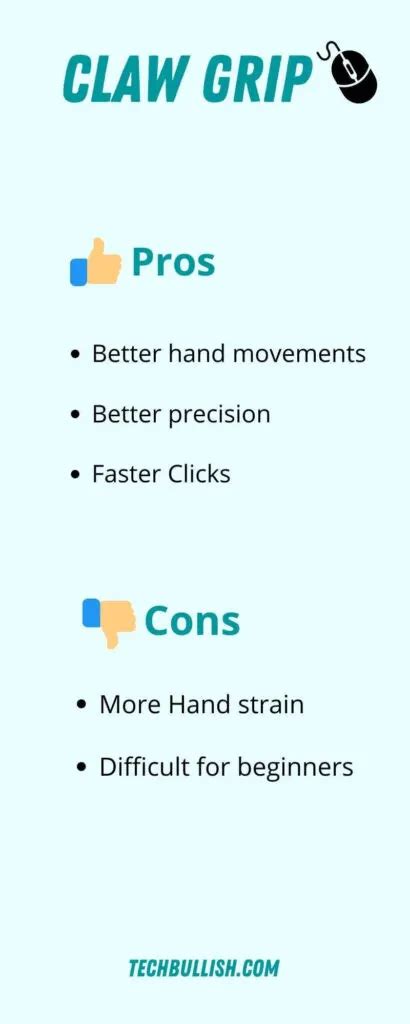
Pros
- Excellent precision for quick adjustments and detailed cursor control
- Fast click response thanks to naturally elevated fingers
- Agile movement style that feels lively and responsive
- Good middle ground between palm grip stability and fingertip grip mobility
- Well suited for gaming, especially titles requiring reaction speed
- Works well for certain productivity tasks involving frequent small movements
Cons
- Can cause finger tension during long sessions
- Less relaxed than palm grip for all-day comfort
- Strongly dependent on mouse shape, size, and button placement
- May require an adjustment period before it feels natural
- Not ideal for every hand size, especially if the mouse is too large or too flat
- Can increase fatigue if the user already grips the mouse too tightly
Claw Grip vs Other Common Mouse Grip Styles
For buyers deciding whether to change grip style, comparison is useful. The claw grip is not objectively the best, but it occupies a practical middle ground.
| Grip Style | Comfort | Precision | Speed | Best For | Main Trade-Off |
|---|---|---|---|---|---|
| Claw Grip | Moderate | High | High | Gaming, fast navigation, mixed use | More finger tension over time |
| Palm Grip | High | Moderate | Moderate | Long office sessions, casual use | Can feel slower and less agile |
| Fingertip Grip | Low to Moderate | High | Very High | Light mice, quick movements, skilled users | Least support and most demanding control |
The claw grip makes the most sense for users who want more responsiveness than palm grip offers, but more support than fingertip grip usually provides.
How Mouse Shape Affects the Claw Grip Experience
No month-long test of the claw grip would be complete without mentioning the most important variable: mouse design. The grip is not a standalone product experience in the way a keyboard switch or display panel might be. It depends heavily on the shell beneath the hand.
Buyers often underestimate this. A claw grip can feel excellent on one mouse and awkward on another, even if the sensor and switches are identical. The most claw-friendly mice tend to share a few traits:
- A supportive rear hump that contacts the lower palm without forcing full contact
- A medium-length body that does not overextend the hand
- Accessible side contours for grip security during lift-off and repositioning
- Main buttons with clear separation and easy actuation from arched fingers
If a mouse is too long, too flat, or too wide, the claw grip often becomes less natural. The user either flattens into a palm grip or overcurls the fingers to compensate. Neither result is ideal.
Discover deals on Electronics — updated daily.
View Offers →Buying Guide: What to Look for If You Want to Use the Claw Grip
Anyone considering a move to the claw grip should think beyond marketing terms like “pro shape” or “esports-ready.” The practical buying decision should center on fit, support, and session length.
1. Match the Mouse to Hand Size
This is the single most important factor. A mouse that is too large forces too much extension; a mouse that is too small may create excessive curling. Buyers should look for a size that allows the lower palm to rest lightly while the fingers remain naturally arched rather than sharply bent.
2. Check the Rear Hump Shape
For claw grip users, the rear section matters more than many expect. A well-positioned hump provides anchor support without swallowing the whole hand. If the back is too low, the grip can feel unsupported. If it is too large, the hand may default into a palm grip posture.
3. Consider Weight Carefully
Lighter mice generally pair well with the claw grip because the style emphasizes quick adjustments and reduced inertia. However, ultralight designs are not automatically better for everyone. Some users prefer a moderate weight for steadier control in productivity work.
4. Evaluate Button Feel
Because the fingers remain more elevated in the claw grip, click feel becomes especially noticeable. Buttons that are too stiff can contribute to fatigue, while those that are too soft may feel vague during repeated inputs. A crisp, balanced click is usually the safest choice.
5. Think About Daily Use, Not Just Gaming
Many buyers discover the claw grip while researching gaming setups, but a mouse is often used for far more than games. If the device will also serve for office work, editing, browsing, and general computing, comfort should be weighted just as heavily as performance. A grip that feels amazing for 45 minutes of gaming may feel far less ideal after six hours of work.
6. Be Realistic About Adaptation Time
Switching to the claw grip may require one to three weeks before it feels natural. Buyers should not judge it solely by the first day unless discomfort is immediate and obvious. There is a difference between adaptation and incompatibility. Mild unfamiliarity often fades; real ergonomic mismatch usually does not.
Common Buyer Questions
Is the claw grip good for work, or only for gaming?
It can be good for both. In office and creative workflows, the claw grip can improve precision and make navigation feel quicker. However, users who spend full days at a desk may still prefer palm grip if maximum comfort is the top priority.
Does the claw grip reduce accuracy?
In this month-long test, it did the opposite. Accuracy improved in small, fast movements. The stronger finger involvement made micro-corrections easier. That said, results depend heavily on the user’s mouse fit and tension habits.
Is the claw grip uncomfortable?
Not inherently, but it is less naturally relaxed than palm grip. For some users that trade-off is worthwhile; for others it becomes tiring over time. Comfort is highly individual.
Should beginners try it?
Yes, but with the understanding that grip style should serve the user, not the other way around. The claw grip is worth trying for anyone seeking more control and responsiveness, but there is no need to force it if another style already feels natural and pain-free.
Final Verdict
After a full month of real-world testing, the claw grip proved to be a highly effective but somewhat specialized mouse grip style. Its strengths are easy to appreciate: sharp cursor control, fast response, and a balanced blend of agility and support. It consistently felt more precise and lively than a traditional palm grip, especially in gaming and detailed desktop tasks.
Its weaknesses are just as important to understand. The claw grip is more demanding on the hand, more sensitive to mouse shape, and less forgiving during very long sessions. It is not the best choice for everyone, and it should not be treated as a universal upgrade.
The overall verdict is positive. For users who care about responsiveness, precision, and a more performance-oriented feel, the claw grip is absolutely worth considering. For users who mainly want maximum comfort with minimal hand tension, a palm-oriented setup may still be the smarter choice. In the end, the claw grip earns its reputation—but only when paired with the right expectations, the right mouse, and a hand posture that stays controlled rather than tense.